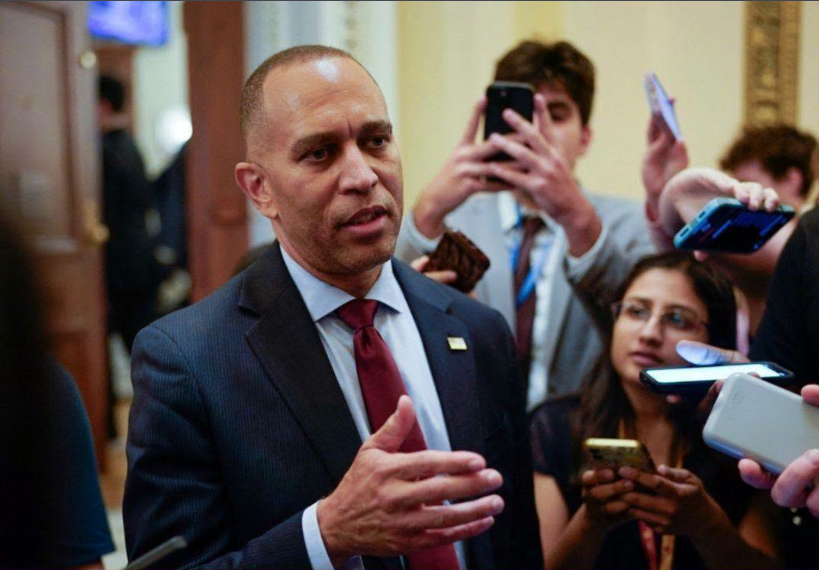
House Minority Leader Hakeem Jeffries is confronting growing internal divisions within the Democratic caucus over U.S. policy toward Israel, as the party debates a controversial proposal to cut American aid to the longtime ally.
The measure, offered by Rep. Thomas Massie (R-Ky.), seeks to eliminate U.S. assistance to Israel. While the amendment is considered unlikely to pass due to insufficient Republican support, it has intensified tensions within the Democratic Party and highlighted its evolving stance on Middle East policy.
Lawmakers had anticipated a vote on the proposal last week, but scheduling disruptions related to unrelated Republican matters delayed action and prompted an early start to the Independence Day recess. The postponement deferred what has become one of the most sensitive debates within the party ahead of the 2026 midterm primaries.
Recent Democratic primaries have underscored these fault lines. In New York and Colorado, challengers critical of Israel and the influence of the American Israel Public Affairs Committee (AIPAC) defeated incumbent Democrats, signaling shifting voter priorities on the issue.
Jeffries, who represents a Brooklyn district with a significant Orthodox Jewish community, has a longstanding record of support for Israel. During his 2012 congressional campaign, Senate Majority Leader Chuck Schumer described him as a “true blue friend of Israel.” However, Jeffries has so far declined to stake out a firm public position on Massie’s amendment, opting instead to facilitate discussion during closed-door caucus meetings.
According to Politico, Jeffries has signaled a cautious approach aimed at managing the party’s diverse views without exacerbating rifts. In comments to reporters, he emphasized the need for a “just and lasting peace” between Israel and the Palestinians and a renewed focus on a two-state solution.
During caucus sessions, Jeffries reportedly referenced a statement from the pro-Israel organization J Street opposing the amendment. Members across the ideological spectrum described the private debates as constructive, with some viewing the format as a potential model for addressing contentious issues.
Still, others warned that simply allowing members to “agree to disagree” may prove unsustainable as the party confronts highly polarized foreign policy questions. Rep. Greg Landsman (D-Ohio), a pro-Israel Democrat, noted that many primary voters are seeking clearer guidance on the issue.
The debate reflects broader changes within the Democratic Party following the October 2023 Hamas attacks on Israel and the subsequent military campaign in Gaza. Support for Israel, once a more unifying position, has become a flashpoint, challenging leaders like Jeffries to balance competing factions.
As the amendment returns to the floor schedule, Jeffries has indicated he will offer more specific direction to the caucus. The episode illustrates the delicate balancing act facing Democratic leadership amid shifting political dynamics.