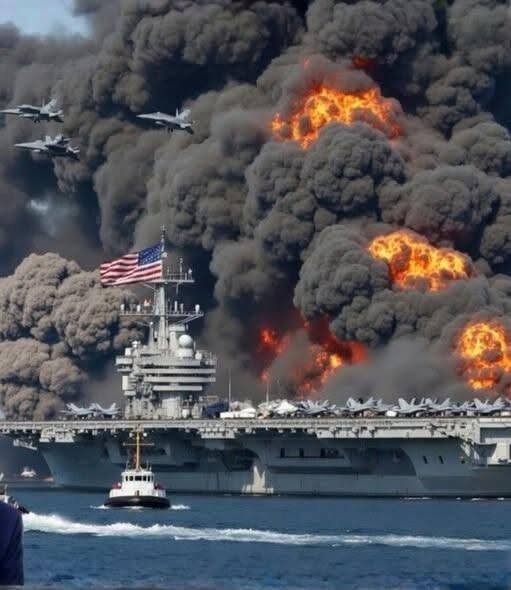
The world is holding its breath as terrifying, unverified reports of a catastrophic strike against a major military vessel have set the internet ablaze. From anonymous forums to viral social media threads, the claim is spreading like wildfire: a heavily fortified warship has been decimated in a silent, deadly operation. Is this the spark that ignites a global conflict, or are we witnessing the most sophisticated digital deception campaign in modern history? As governments remain ominously tight-lipped, the silence is deafening. Every passing second of uncertainty brings us closer to the edge, but the truth remains locked behind a curtain of steel.
In an era where information travels faster than light, the boundary between verified intelligence and manufactured fiction has become terrifyingly thin. We live in a landscape where a single, uncorroborated post can trigger ripples across international financial markets, cause diplomatic tremors, and incite widespread panic among the public. The recent surge of speculation regarding a high-profile attack on a naval vessel serves as a masterclass in how fragile our collective perception of reality has become. Despite the frenzy surrounding these claims, there is a stark, undeniable void: not a single credible or official government source has confirmed that such an incident ever took place.
When major geopolitical events unfold, the absence of confirmation is often as informative as an official statement. Defense ministries, intelligence agencies, and international security councils operate under rigid protocols designed to prevent the catastrophic consequences of misinformation. In the high-stakes theater of global security, silence is a deliberate choice. It allows for the verification of raw intelligence, the assessment of security risks, and the delicate coordination with international allies. Yet, to the public accustomed to instant, real-time updates, this silence is frequently misinterpreted as a cover-up or a sign of incompetence.
The mechanics of this digital contagion are fueled by the very architecture of our online existence. Social media platforms are engineered to prioritize content that sparks emotional responses. Algorithms do not distinguish between a nuanced, evidence-based report and a sensationalist, fear-mongering narrative; they prioritize engagement. Consequently, dramatic claims regarding military strikes or national security threats are amplified at an exponential rate. By the time a cautious, fact-based update is released, the rumor has already hardened into an established truth within online communities. This creates a dangerous feedback loop where speculation functions as the primary source of information, effectively outpacing the responsible reporting of journalists and official state entities.
Military and defense verification processes are, by their very nature, slow and methodical. This is not a failure of transparency but a safeguard against disaster. Before confirming a major military incident, governments must cross-reference data from multiple, often sensitive, intelligence sources, evaluate the potential for diplomatic escalation, and consider the security of their personnel. A premature, erroneous confirmation of an attack could lead to unnecessary public fear, cause massive volatility in the stock market, or even accidentally trigger a diplomatic crisis that no one intended to start. The caution displayed by these institutions is a necessary bulwark against the chaos of misinformation.
e risks associated with the rapid spread of these unverified claims are profound. When we treat unverified rumors as breaking news, we are not just consuming content; we are participating in a process that can destabilize nations. False reports have the power to influence currency valuations, shift the momentum of geopolitical negotiations, and put lives at risk by spreading panic. In several historical instances, misinformation during periods of high tension has forced leaders into reactionary postures, narrowing the window for peaceful diplomacy and increasing the likelihood of miscalculation.
Strategic studies experts emphasize that in the absence of verified facts, the only responsible analytical position is one of extreme skepticism. When reliable data is unavailable, the focus must shift from inventing narratives to acknowledging uncertainty. Instead of drawing premature conclusions about military capabilities or potential aggressors, we must resist the urge to fill the vacuum of information with our own fears and projections. The human tendency to seek patterns in chaos is powerful, but in the context of international security, it is a liability.
Ultimately, this situation serves as a stark reminder of the vital necessity of media literacy and the virtue of patience. We are currently operating in an environment where information is weaponized, and rumors are treated with the same weight as official dispatches. To preserve a grounded understanding of the world, we must adopt a more disciplined approach to the news we consume and share. Prioritizing accuracy over the speed of discovery is not just a standard of ethical journalism; it is a civic duty.
As the digital fog continues to swirl around this mystery, the most powerful tool at the public’s disposal is the ability to wait. We must refuse to allow our emotions to be manipulated by sensationalist headlines that offer shock without substance. History has shown us time and again that while the truth may be slower to emerge than a viral rumor, it is the only foundation upon which a stable society can rest. Until verified sources emerge, the most prudent course of action is to step back from the frenzy and recognize that not every claim, no matter how dramatic, deserves our belief or our participation in its spread. The world remains, for now, a place where careful analysis matters more than the frantic pulse of the internet.