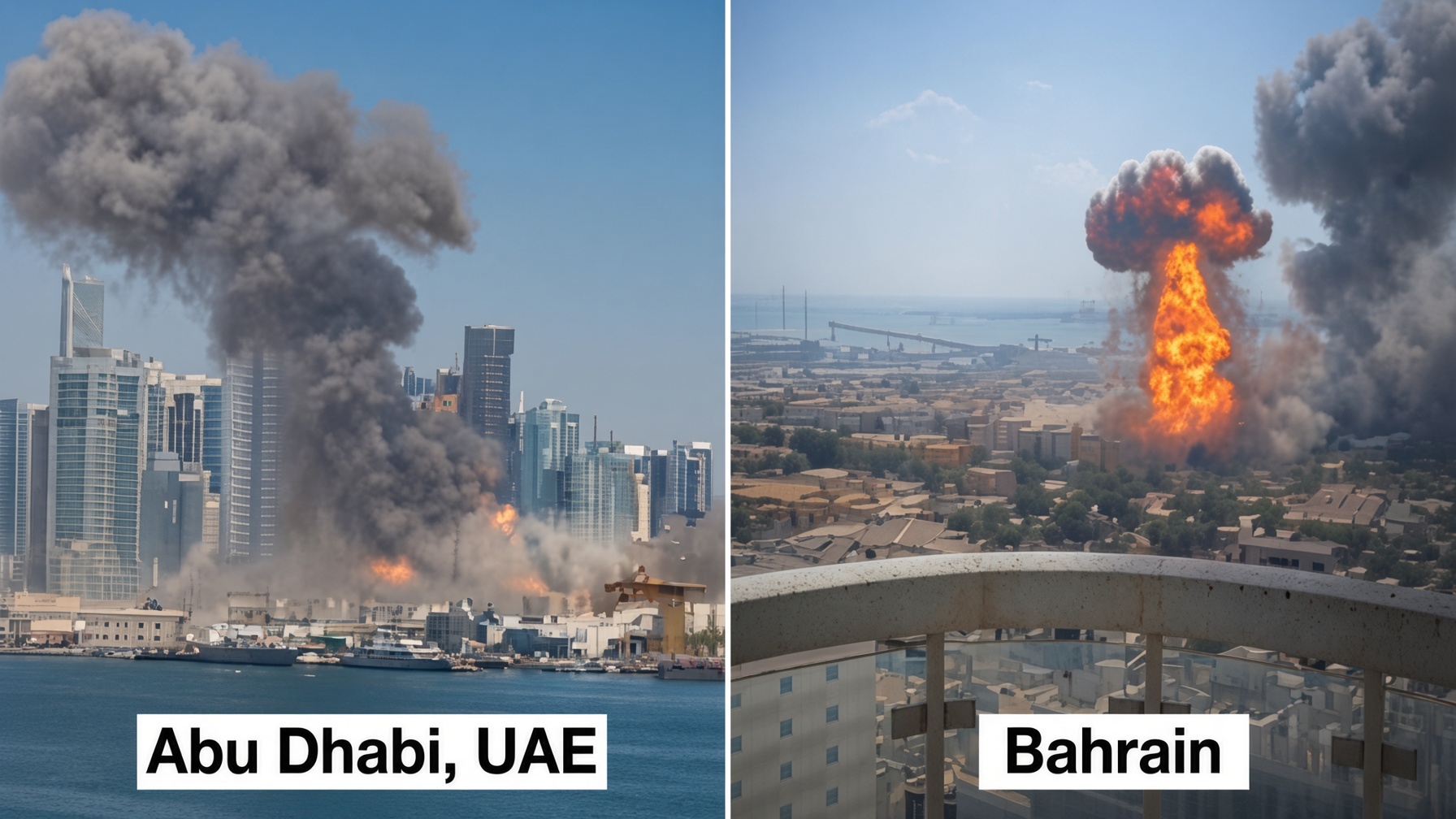
PERSIAN GULF — Tensions across the Middle East have intensified dramatically as Iran has launched repeated missile and drone attacks against locations associated with U.S. military forces and strategic infrastructure across the Persian Gulf, raising fresh concerns that the conflict could spread further throughout the region.
The attacks have placed Bahrain, Qatar, Kuwait and the United Arab Emirates on heightened alert, with air-defense systems activated and emergency measures implemented in response to incoming threats. The escalation underscores the vulnerability of Gulf states that host significant American military assets and have become increasingly exposed as the conflict between Washington and Tehran continues.
The latest developments come after months of confrontation involving military strikes, attacks on shipping and growing tensions surrounding the Strait of Hormuz. Reuters and other international reporting have documented previous Iranian attacks against Gulf states hosting U.S. military facilities, while U.S. Central Command has acknowledged ongoing combat operations against Iranian military and Islamic Revolutionary Guard Corps targets.
UAE Strengthens Air Defenses
In the United Arab Emirates, security concerns have remained particularly high around Abu Dhabi and military installations hosting or supporting U.S. forces.
Al Dhafra Air Base, located near Abu Dhabi, has been repeatedly identified as a strategically important U.S.-linked facility and has previously been targeted during Iranian retaliation. Reports of explosions and aerial interceptions in the area have prompted heightened security measures as authorities assess potential damage and monitor for additional threats.
Iranian forces have previously claimed attacks against American military infrastructure in the UAE using combinations of missiles and drones. Reuters reporting in September also documented Iranian claims that U.S.-linked facilities in the UAE and Kuwait had been targeted.
The repeated use of low-flying drones and ballistic missiles has complicated defensive efforts. Gulf governments have invested heavily in air-defense systems, but the broad geographic footprint of military installations, energy facilities, airports and other critical infrastructure creates a difficult security environment.
Bahrain Faces Renewed Pressure
Bahrain has also remained directly exposed because of its role as the headquarters of the U.S. Navy’s Fifth Fleet.
The American naval presence in Bahrain makes the island kingdom one of the most strategically important U.S. military locations in the Gulf. Iranian attacks have previously targeted sites associated with American forces, including facilities in the Jufair and Bahrain Naval Support Area.
During earlier attacks, air-raid sirens sounded as Bahraini and allied defense systems responded to incoming missiles and drones. Reuters reported in July that Iran’s Islamic Revolutionary Guard Corps claimed responsibility for attacks on U.S. military locations in Bahrain and Kuwait, while authorities in both countries reported defensive responses.
For Bahrain, the challenge extends beyond protecting military facilities. The country’s small size means that attacks near strategic installations can also create risks for civilian communities, transportation networks and critical infrastructure.
Qatar Remains a Major Strategic Target
Qatar faces a similar challenge because it hosts Al Udeid Air Base, one of the most important U.S. military installations in the Middle East.
The base serves as a major regional command and logistics hub for American military operations. Reuters has described Al Udeid as the forward headquarters for U.S. Central Command, with thousands of American personnel based at the installation.
Any attack involving the base therefore carries implications far beyond Qatar’s borders. Missile or drone activity around Al Udeid could affect U.S. military operations across a wide area while simultaneously placing Qatar’s civilian population on heightened alert.
Qatari defenses have previously intercepted incoming threats during Iranian attacks, illustrating the increasingly complex air-defense environment facing Gulf nations.
Kuwait Caught in the Escalation
Kuwait has also experienced attacks involving missiles and drones directed toward locations associated with American forces.
Iranian military statements have claimed strikes against U.S.-linked facilities in Kuwait, including air bases and other military infrastructure. Reuters reporting has previously documented Iranian attacks involving drones and missiles against American military sites in the country.
Kuwaiti authorities have repeatedly urged residents to follow official instructions and remain alert during periods of heightened military activity.
The attacks demonstrate how quickly the conflict can move beyond the immediate battlefield in Iran and affect neighboring countries that host foreign military forces.
Strait of Hormuz Raises Global Concerns
The broader consequences extend well beyond the Gulf itself.
At the center of the crisis is the Strait of Hormuz, a narrow maritime passage through which a major share of global energy supplies normally travels. Continuing military confrontation around the waterway has already disrupted shipping and placed additional pressure on international energy markets.
Reuters reported in September that tit-for-tat attacks on shipping near the strait had become the largest declared wave of maritime attacks since the conflict began, with oil prices rising sharply as uncertainty increased.
The situation has also contributed to broader disruptions in global energy transportation. Saudi Arabia has sought to restore alternative export routes through its East-West pipeline, which provides a way to move crude toward the Red Sea without relying entirely on Hormuz.
A Region on High Alert
The continuing exchanges between Iran and the United States have created a dangerous security environment for Gulf governments caught between military confrontation and economic stability.
U.S. forces remain deployed across the region, while Iran continues to possess missile, drone and maritime capabilities capable of threatening military and commercial targets. U.S. Central Command has said more than 50,000 American service members are deployed across the broader Middle East and remain at high readiness.
For Gulf nations, the immediate priority is preventing further attacks from causing civilian casualties, damaging critical infrastructure or disrupting energy exports. For Washington and Tehran, however, the central challenge is avoiding another cycle of retaliation that could widen the conflict.
With diplomatic efforts still uncertain and military activity continuing around the Gulf, officials throughout the region are closely monitoring the skies, military installations and shipping lanes for signs of another escalation.