WASHINGTON — Hostilities between Washington and Tehran reached a critical flashpoint in late July after an Iranian ballistic missile barrage triggered retaliatory U.S.-Saudi airstrikes in Iraq and a sweeping wave of direct American attacks inside Iranian territory.
According to U.S. Central Command (CENTCOM), the rapid sequence of military operations unfolded over a tense 48-hour period, transforming an ongoing shadow conflict into a direct, multi-front confrontation involving regional allies, proxy militias, and vital global energy corridors.
Missile Interceptions and Joint U.S.-Saudi Retaliation
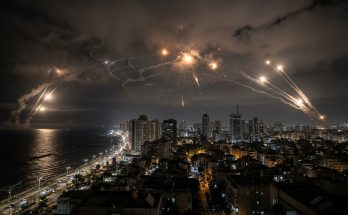
The latest spiral began on July 28, when Iran’s Islamic Revolutionary Guard Corps (IRGC) launched a barrage of ballistic missiles directly from Iranian soil toward American military installations across the Middle East. CENTCOM characterized the launches as an attempted surprise attack. U.S. air defense systems intercepted the incoming projectiles, preventing immediate casualties, though American troops across the theater were placed on heightened alert.
Within hours of the missile launches, the United States and Saudi Arabia executed a coordinated military response. American and Saudi fighter jets carried out precision airstrikes against multiple weapons depots and logistics hubs in eastern Iraq operated by Iran-aligned militias.
Military officials stated that the targeted facilities were directly linked to groups acting under IRGC direction to strike U.S. personnel and Saudi energy infrastructure. CENTCOM noted that the joint strikes came on the heels of more than 30 drone attacks launched against coalition and regional targets over the preceding 72 hours.
The operation underscored deepening military coordination between Washington and Riyadh. Saudi Arabia has found itself increasingly exposed to cross-border drone and missile threats, with its oil refineries and export terminals remaining high-value targets capable of sending shockwaves through global energy markets.
A Backdrop of Sustained Militia Pressure
In contextualizing the escalation, CENTCOM revealed that Iran-backed militias in Iraq had conducted more than 600 attempted attacks against American citizens and facilities between February and April 2026. While that figure reflects internal U.S. military assessments rather than an independent tally, it highlights the relentless low-level attrition that preceded July’s dramatic flare-up.
Washington has maintained a doctrine of proportional yet decisive deterrence, arguing that persistent attacks on its regional footprint require direct degradation of enemy capabilities. Over the course of the broader standoff, U.S. forces have systematically targeted Iranian and proxy military assets, including air-defense batteries, command-and-control nodes, coastal radar stations, missile launchers, and naval vessels.
U.S. Strikes Cross Into Iranian Territory
Rather than subsiding after the raids in Iraq, the confrontation expanded sharply on July 29. CENTCOM announced that U.S. forces had executed a major wave of strikes against dozens of IRGC-affiliated targets directly inside Iran.
The target package was comprehensive, striking military command centers, ballistic missile and drone production facilities, coastal surveillance networks, and maritime assets. According to CENTCOM, the primary objective was to neutralize imminent threats to U.S. troops, international commercial shipping, and Gulf partner nations.
The trajectory of the conflict—moving from direct Iranian missile fire to joint U.S.-Saudi strikes in Iraq, and finally to large-scale American bombing runs inside Iran—marks a significant departure from previous rules of engagement, which largely confined kinetic exchanges to proxy battlegrounds.
A Volatile Multi-Front Theater
The clashes are playing out across a sprawling geopolitical chessboard encompassing the Persian Gulf, Iraq, Yemen, and the Strait of Hormuz. Because a massive percentage of the world’s seaborne crude oil passes through the Strait of Hormuz, any sustained military disruption threatens to choke global supply chains and destabilize international economies. Consequently, U.S. naval and air assets remain heavily focused on guaranteeing freedom of navigation alongside force protection.
Complicating the security calculus is the active involvement of Iran-aligned Houthi militants in Yemen, whose continued missile and drone launches toward Saudi territory and Red Sea shipping lanes have stretched regional air defenses. With non-state actors operating across multiple borders, isolated tactical incidents are increasingly indistinguishable from a coordinated regional war.
The Cycle of Escalation
For Washington, the events of late July laid bare the dual-layered threat facing its Middle East posture: simultaneous exposure to sovereign Iranian ballistic capabilities and decentralized proxy networks. For Tehran, sustained U.S. strikes on domestic military infrastructure represent an acute threat to its conventional deterrence and regional influence.
With every military response carrying the risk of an even broader counter-strike, the July clashes have locked the United States, Iran, and neighboring Gulf states into a volatile cycle. As operations continue across land, air, and sea, military planners face the daunting task of defending personnel, commercial vessels, and critical energy infrastructure while trying to prevent the conflict from spiraling into an uncontrollable regional war.