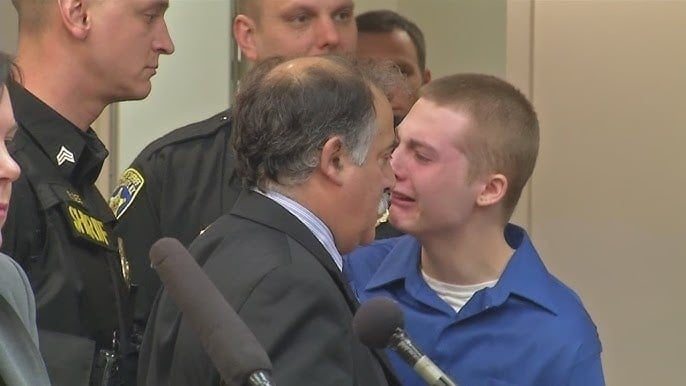
The atmosphere inside the courtroom was thick with palpable tension as the young defendant stood before the bench, his youthful features contrasting sharply with the gravity of the accusations leveled against him. When the judge began to read the final verdict, a collective gasp rippled through the spectators, and the silence that followed was absolute. A sentence of 452 years was handed down, a duration that defied human comprehension and effectively erased the boy’s future before it had truly begun. The sheer magnitude of the punishment left everyone in the room grappling with a harrowing question: how can a child be responsible for a lifetime spanning centuries?
As the judge concluded the sentencing, the courtroom became a stage for raw, unfiltered human emotion. The families of the victims, who had sat in stoic silence throughout the grueling trial, finally allowed their grief and fury to surface. For them, the monumental length of the sentence was the only acceptable response to lives that had been irreparably shattered. They spoke of stolen futures and permanent voids, arguing that the severity of the punishment was not merely a reaction, but a necessary form of accountability and a promise of protection for the community. In their eyes, the law had finally addressed a catastrophic wrong with the absolute finality it deserved.
Conversely, the defense presented a narrative that focused on the complexities of a life barely lived. They painted a picture of a developing youth, an individual whose path had been fundamentally altered by toxic circumstances and a lack of proper guidance. They argued that by stripping away any hope of freedom, the system was not serving justice, but simply discarding a person who remained capable of fundamental change. To the defense team, the sentence was a tragic admission of failure—a refusal to acknowledge the potential for growth and the possibility that an adolescent could transcend the most disastrous chapter of their existence.
Outside the heavy doors of the courthouse, the case ignited a wildfire of national debate that transcended the specific details of the crime. The public discourse became deeply polarized, reflecting the nation’s broader struggle to reconcile the need for retribution with the potential for rehabilitation. Those in favor of the verdict cited the unspeakable nature of the offenses, arguing that certain acts warrant a permanent removal from society regardless of the age of the perpetrator. They maintained that justice is not just about the individual, but about maintaining the moral standards of the collective, and that some lines, when crossed, necessitate the total forfeiture of a future.